Queer Places:
University of Oxford, Oxford, Oxfordshire OX1 3PA
Ingleborough Hall, Clapham, Lancaster LA2 8EF, United Kingdom
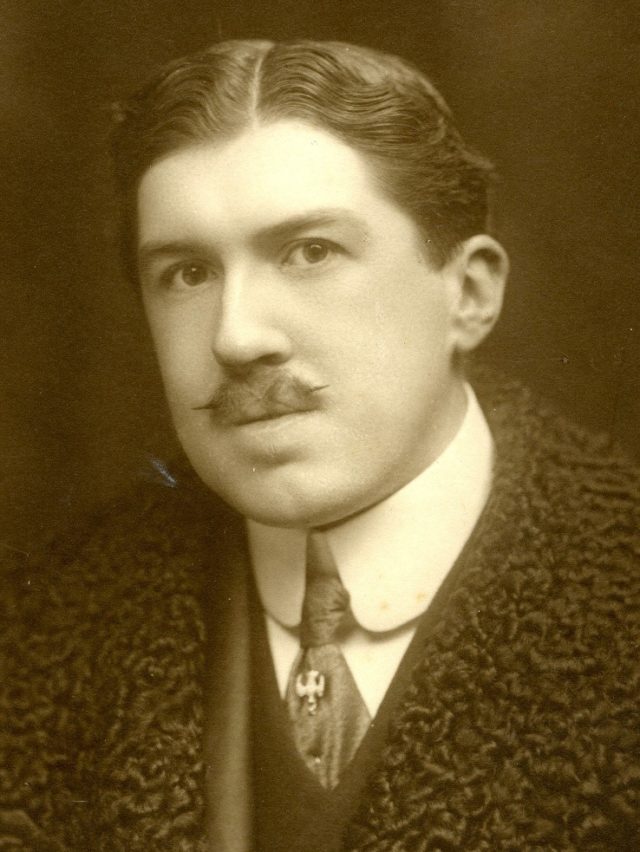 Reginald John Farrer (February 17, 1880 – October 17, 1920) was born into a wealthy family residing in Clapham, North Yorkshire, and spent his early
years educated at home due to a speech impediment and treatment for a cleft palate. During this isolated childhood, he developed a deep fascination with
botany and high-altitude flora. By age fourteen, he had constructed his first rock garden in a disused quarry. He matriculated at Balliol College,
Oxford, in 1897, where he assisted in designing the rock garden at St John's College before graduating in 1902.
Reginald John Farrer (February 17, 1880 – October 17, 1920) was born into a wealthy family residing in Clapham, North Yorkshire, and spent his early
years educated at home due to a speech impediment and treatment for a cleft palate. During this isolated childhood, he developed a deep fascination with
botany and high-altitude flora. By age fourteen, he had constructed his first rock garden in a disused quarry. He matriculated at Balliol College,
Oxford, in 1897, where he assisted in designing the rock garden at St John's College before graduating in 1902.
Following his studies, Farrer embarked on his first major overseas journey to East Asia, exploring Japan, China, and Korea. Influenced by Japanese
gardening traditions, he advocated for a naturalistic approach to rock garden design, which he detailed in his debut book, The Garden of Asia. Returning
to England, he established the Craven Nursery in Clapham to cultivate Asian alpines. In 1907, he published My Rock Garden, an immensely popular text that
remained in print for decades and established his reputation as a leading figure in alpine horticulture. He continued to write prolifically about his
travels through the Italian, French, and Swiss Alps, publishing Alpines and Bog Plants, In a Yorkshire Garden, and The Dolomites: King Laurin's
Garden.
In 1908, Farrer traveled to Ceylon, where he formally converted to Buddhism. He returned to East Asia in 1914 alongside plant collector William Purdom
for a two-year expedition through Gansu and Qinghai in northwest China. This journey yielded numerous plant and seed specimens for British gardens,
documented in his works On the Eaves of the World and the posthumously published The Rainbow Bridge. After serving as a war journalist for the Ministry
of Information during the First World War, Farrer launched a final plant-hunting expedition to Upper Burma in 1919 accompanied by
Euan Hillhouse Methven Cox. Farrer died on October 17, 1920, at Nyitadi along the remote border
between Burma and China at the age of forty.
Beyond his horticultural achievements, Farrer’s travels provided an escape from the rigid social expectations and moral constraints of Edwardian
Britain. For gay men of his era, international exploration offered a degree of freedom unattainable at home. The remote, high-altitude landscapes of the
Alps and Asia served as spaces where Farrer could pursue aesthetic and romantic relationships with men outside the scrutiny of British society. He
regularly undertook expeditions through the European mountains accompanied by close male companions, including fellow plantsmen
E.A. Bowles, Clarence Elliott, and
Gerard Collier, cultivating a life centered on shared passions for botany, landscape, and art away from
domestic societal pressures.
References:
- Charlesworth, Michael. The Modern Culture of Reginald Farrer: Landscape, Literature, and Buddhism. Cambridge: Legenda, 2018.
- Cox, E.H.M. The Plant Introductions of Reginald Farrer. London: New Flora and Silva Ltd., 1930.
- Massingham, Betty. A Century of Gardeners. London: Faber & Faber, 1982.
- Shulman, Nicola. A Rage for Rock Gardening: The Story of Reginald Farrer, Gardener, Writer and Plant Collector. London: Short Books, 2011.
- Watt, Alistair. Purdom and Farrer: Plant Hunters on the Eaves of China. Melbourne: Alistair Watt, 2019.
- Royal Botanic Garden Edinburgh (RBGE) Archives (GB 235 RJF): Holds the principal collection of Farrer's papers, including extensive family correspondence (particularly letters to his mother), notebooks, field journals, plant collection notes, landscape watercolors, and photographic albums from his expeditions to China (1914–1915) and Upper Burma (1919–1920). It also contains personal correspondence, such as his letters to Ernest Frederick Gye (GB 235 RJF/4) and Lady Celia Brunel Noble (GB 235 RJF/5).
- Oxford Dictionary of National Biography (ODNB): Reference entry for Farrer, Reginald John (1880–1920) by the Oxford University Press.
- The Garden of Asia (1904)
- My Rock Garden (1907)
- Alpines and Bog Plants (1908)
- In Old Ceylon (1908)
- In a Yorkshire Garden (1909)
- Among the Hills (1910)
- The Dolomites: King Laurin's Garden (1913)
- On the Eaves of the World (2 vols., 1917)
- The English Rock-Garden (2 vols., 1919)
- The Rainbow Bridge (1921, published posthumously)
- Cox, E.H.M. Farrer's Last Journey, Upper Burma 1919–20. London: Dulau & Co., 1926.
Support this project
This website is a passion project researched, developed, and funded entirely by me. If you find the content valuable and would like to help support the ongoing research and hosting costs, any contribution is deeply appreciated.
Thank you for keeping this independent resource alive!
My books on Amazon: Elisa Rolle's books
BACK TO HOME PAGE